independent guide · blackjack · checked 21 October 2026
Shuffle blackjack for Indian players: 18 tables from 0.44% edge
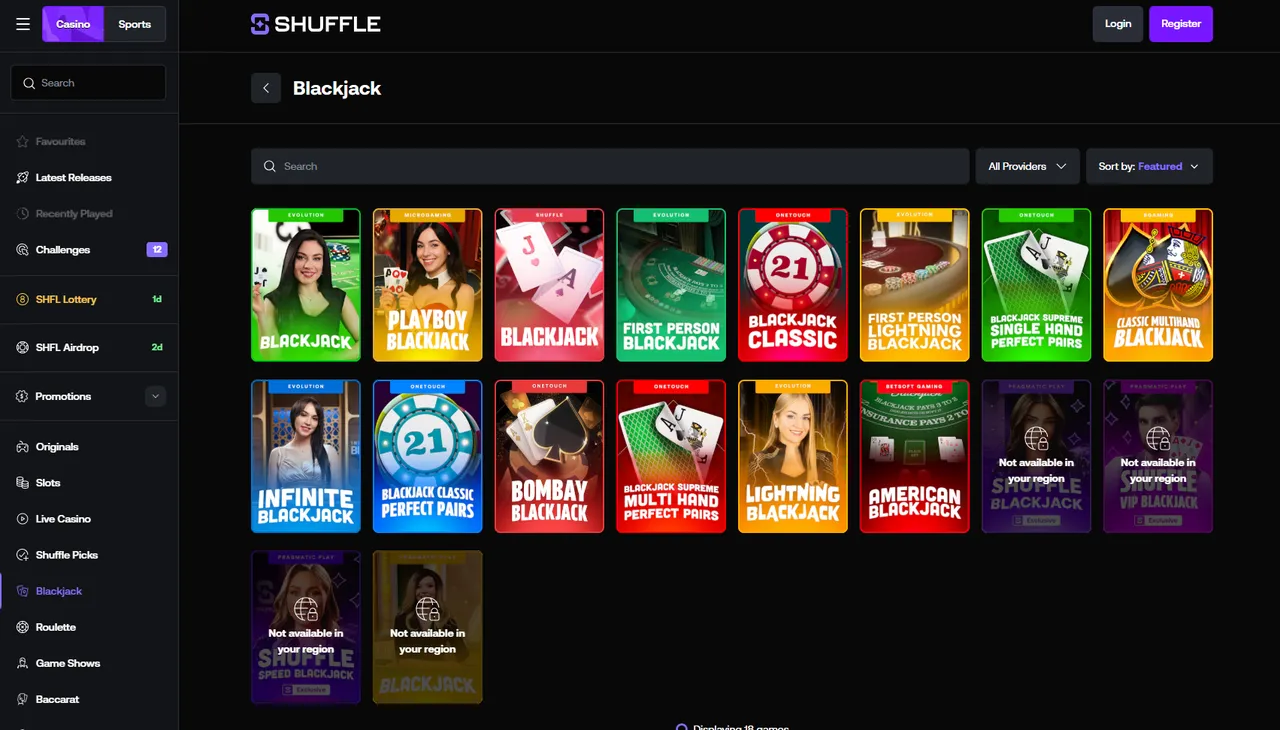
The Blackjack category held 18 games on 21 October 2026: live tables from Evolution and Pragmatic Play, First Person RNG tables from Evolution, digital tables from OneTouch, BGaming and Betsoft, and the provably fair Original. Blackjack is the game where hit, stand, double and split change the result, and the table rules decide the baseline: 3:2 against 6:5 is the single most expensive detail in the lobby.
Checked on


| Metric | Value |
|---|---|
| Games | 18 |
| Lowest edge | 0.44% Lightning Blackjack |
| Original | 0.52% max bet $50,000 |
| Live studios | 2 Evolution, Pragmatic Play |
| Demo | 9 of 18 RNG tables only |
| Payout to check | 3:2 not 6:5 |
Blackjack tables
Twelve of the 18 games in the Blackjack category on 21 October 2026, with the house edge from the catalogue data. Live tables have no demo mode; the RNG tables from OneTouch, BGaming, Betsoft and the Original open with play money.
-
Evolution
Blackjack Live
-
Evolution
Infinite Blackjack
-
Evolution
Lightning Blackjack
-
Evolution
First Person Blackjack
-
Evolution
First Person Lightning Blackjack
-
Shuffle Originals
Blackjack
-
Pragmatic Play

Shuffle Blackjack 1
-
Pragmatic Play

Shuffle VIP Blackjack
-
Maxxi Labs

Playboy Blackjack
-
OneTouch
Blackjack Classic
-
BGaming
Classic Multihand Blackjack
-
Betsoft
American Blackjack
All 18 blackjack games by provider
The category mixes three kinds of table: live dealers from Evolution and a dedicated set of Pragmatic Play tables run for the operator's players, First Person RNG tables from Evolution with live-style visuals, and classic digital tables from OneTouch, BGaming and Betsoft. The table lists every game in the category with its house edge on 21 October 2026.
| Game | Provider | Format | House edge |
|---|---|---|---|
| Lightning Blackjack | Evolution | live, multipliers | 0.44% |
| First Person Lightning Blackjack | Evolution | RNG, multipliers | 0.44% |
| Blackjack Lobby | Pragmatic Play | live | 0.51% |
| Blackjack (Original) | Shuffle Games | RNG, provably fair | 0.52% |
| Infinite Blackjack | Evolution | live, unlimited seats | 0.53% |
| Playboy Blackjack | Maxxi Labs | live | 0.56% |
| Shuffle Blackjack 1 | Pragmatic Play | live, dedicated table | 0.59% |
| Shuffle VIP Blackjack | Pragmatic Play | live, higher limits | 0.59% |
| Shuffle Speed Blackjack 1 | Pragmatic Play | live, short window | 0.59% |
| Classic Multihand Blackjack | BGaming | RNG, multi-hand | 0.60% |
| Blackjack Classic | OneTouch | RNG | 0.65% |
| Blackjack Live | Evolution | live, seated | 0.71% |
| First Person Blackjack | Evolution | RNG | 0.71% |
| Blackjack Classic Perfect Pairs | OneTouch | RNG, side bet | 0.86% |
| Blackjack Supreme Single Hand Perfect Pairs | OneTouch | RNG, side bet | 0.87% |
| Blackjack Supreme Multi Hand Perfect Pairs | OneTouch | RNG, side bet | 0.87% |
| Bombay Blackjack | OneTouch | RNG | 0.88% |
| American Blackjack | Betsoft | RNG, 3D | 1.02% |
The edge in the catalogue data is the figure the operator publishes per game; for Lightning tables it already includes the per-round fee that funds the multipliers. The three Pragmatic Play tables named Shuffle are marked as restricted in India in the catalogue data.
The Shuffle India guide opens with an overview of the catalogue, the cashier, the rewards and the law; this page goes into one part of it in detail.
Formats: classic, live, First Person, Lightning, multi-hand
Formats are not cosmetic: they change the pace, the limits, the features and the feel of a session. All of them draw on the same wallet, so a table can be changed mid-session without a new deposit or a confirmation wait.
| Format | Best for | What to expect |
|---|---|---|
| Classic RNG blackjack | learning, steady play | plain table, quick hands, standard rules, demo mode |
| Live dealer blackjack | the feel of a real table | a dealer on camera, a slower beat, seated or unlimited |
| First Person blackjack | fast solo sessions | live-style table rendered by RNG, no other players to wait for |
| Lightning blackjack | higher volatility | random multipliers on winning hands, paid for by a fee on every round |
| Multi-hand blackjack | more action per round | several hands at once, higher variance |
| Side-bet tables | variety | Perfect Pairs and 21+3, usually a higher edge than the main hand |
Seats, Infinite tables and bet behind
A seated live table gives each player a hand and may be full. Infinite Blackjack deals a single hand that each player then plays on their own: nobody waits for a seat, and nobody else's decision changes the shoe. Bet behind stakes on another player's hand without a seat: their decisions and their mistakes decide the result. The chapter on the live casino covers the betting window, stream quality and the studios.
Rules that change the odds
Two tables can look identical and differ in expected result because the rules differ. The information panel of each table lists them; the table below is the checklist the operator's blackjack page gives, in the same order.
| Rule | What to look for | Why it matters |
|---|---|---|
| Blackjack payout | 3:2 is the standard | a 6:5 payout raises the house edge sharply |
| Dealer soft 17 | dealer stands on soft 17 | a dealer that hits soft 17 slightly favours the house |
| Doubling | double on more totals, double after split | more profitable decision spots |
| Splitting | re-splits allowed, split aces rules | decides how strong pairs are |
| Surrender | offered or not | cuts losses in specific bad matchups |
| Side bets | optional | Perfect Pairs 2.00% and 21+3 3.68% on the Original |
The Original publishes its rules in full: six decks, dealer stands on soft 17, double on any two cards, one split, no surrender, blackjack pays 3:2, insurance 2:1, maximum bet $50,000 with side bets capped at $10,000 and a maximum payout of $2,000,000. A 6:5 table cannot be outplayed over time; table selection comes before strategy.
Basic strategy: the decisions that move the needle
Basic strategy is the known optimal baseline. Memorising the whole chart is not required to play better than most of the table; making the high-impact decisions correctly is: doubling, splitting and the hard totals from 12 to 16. The six rules below remove the most expensive feel-based decisions.
- aces and eights are split every time, tens and fives never;
- a hard 11 is doubled wherever the table allows it;
- a hard total of 17 or more stands;
- a hard 12 to 16 stands when the dealer shows 4, 5 or 6 and takes a card against anything stronger;
- insurance is declined as a rule;
- side bets and Lightning multipliers are entertainment at a higher price, not part of the plan.
Played this way at a 3:2 table, blackjack returns about 99.5%; the Original publishes 99.48% with correct play and runs from a 0.001 USD minimum with every hand verifiable, which makes it the practice table before a live seat. Short sessions are dominated by variance; over time the table rules and the decisions decide how much of the baseline is kept.
Side bets and Lightning multipliers
Perfect Pairs pays when the first two cards form a pair, in categories such as mixed, coloured and perfect, with table-specific payouts; 21+3 combines the two player cards and the dealer's upcard into a poker hand. Both carry a higher edge than the main hand. Lightning tables add random multipliers to winning hands and charge for them through a per-round fee, so the session variance is higher and bet sizing should follow; a Lightning table is not a classic table with the same risk.
Choosing a blackjack table
The operator's blackjack page sorts the choice by goal; the list below keeps its order.
- strong fundamentals: a classic table with straightforward rules and no side bets until the main-hand decisions are consistent;
- the most immersive session: a live table with visible dealing and table pacing;
- speed and control: First Person Blackjack, faster than live because no other player is waited on;
- higher volatility: Lightning and multi-hand formats, with the bankroll discipline they require.
Blackjack can feel close because hands are frequent and often decided by small margins, which makes chasing losses easy. A session budget set before the first hand, a fixed base unit, multi-hand instead of a larger unit for more action, and a break after a big swing are the four habits the operator's page recommends; the chapter on responsible gambling tools covers the account tools.
How to play blackjack on Shuffle
Number cards count their face value, jacks, queens and kings count 10, and an ace counts 1 or 11, whichever helps the hand. Every round follows the same sequence.
- Place the bet; the player and the dealer each receive two cards.
- Decide how to play the hand: hit, stand, double or split.
- The dealer completes the hand under the fixed table rules.
- The round settles as a win, a loss or a push, and the payout is credited to the balance.
Deposits land in the same wallet that covers the casino and the sportsbook, bets settle in the chosen crypto asset, and every blackjack bet earns 5% of the house edge as rakeback and 1 XP per $1 from Bronze 1; the chapter on the VIP program has the calculator. Access to the platform depends on the law of the user's state and country; the chapter on the legal status of online casinos in India explains the position. Play is for adults aged 18 and over; gambling carries the risk of losing money.
The Blackjack category in the casino lobby shows the limits and the rules of every table in its information panel.
Frequently asked questions
Short answers on blackjack formats, rules and strategy.
Which blackjack game is the right start?
A classic table without Lightning features or side bets, paying 3:2. The Original and First Person Blackjack offer the same decisions with a demo or a 0.001 USD minimum before a live seat.
What is the difference between live and First Person blackjack?
A live table shows a real dealer in a studio. First Person Blackjack renders the same table with an RNG, keeps the same decisions and runs faster because nobody else is at it.
Which blackjack has the lowest house edge?
Lightning Blackjack and its First Person version publish 0.44% in the catalogue data; the Original publishes 0.52%, Infinite Blackjack 0.53%. All assume correct play at a 3:2 table.
Are side bets like Perfect Pairs worth playing?
They are optional, built for entertainment and variance, and carry a higher house edge than the main hand: 2.00% for Perfect Pairs and 3.68% for 21+3 on the Original.
Is blackjack luck or skill?
Short sessions are dominated by variance. Over time the table rules and the decisions matter: table selection and basic strategy bring the result close to the best possible expectation for the game.
Does blackjack work on mobile?
Yes. Every table runs in the browser on iOS and Android without an application.